Twin-Core 6 mm² PV Wire: One Run, Two Cores
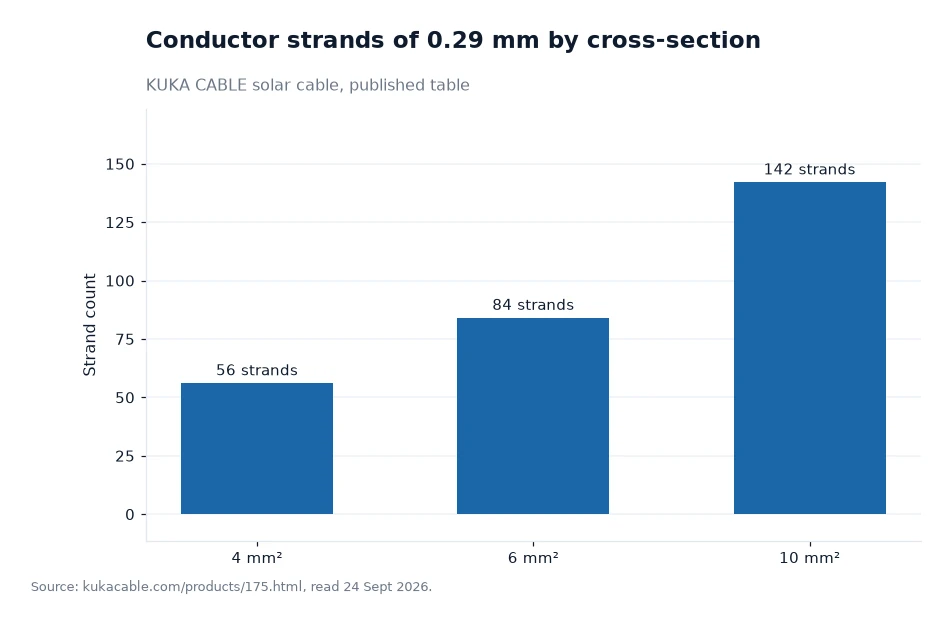
Twin-core PV wire puts the positive and the negative conductor inside one jacket, so a rooftop row needs a single run where two single-core cables used to be laid side by side. The table published by KUKA CABLE gives the 6 mm² conductor as 84 strands of 0.29 mm tinned copper, a finished diameter of 6.0 mm and 78 g per metre, and gives 4 mm² at 56 strands and 10 mm² at 142 strands of the same wire.
Key takeaways
- Each 6 mm² core is built from 84 strands of 0.29 mm tinned copper, the finished cable measures 6.0 mm across and it weighs 78 g per metre.
- The rating stays at DC 1.8/1.8 kV, with a 10 kV spark test during production and a 6.5 kV AC test at 50 Hz for five minutes on the finished cable.
- Working range: −40 °C at the cold end of the ambient scale, +90 °C at the top, with a fault allowance that lets the conductor reach +120 °C for 20,000 hours or, for five seconds only, +250 °C.
- Bending radius is 4 times the outer diameter; by my own arithmetic on the published 6.0 mm figure that is 24 mm for the 6 mm² size.
What two cores in one jacket change on a roof
On a mounting rail, one twin-core run takes a single clip where two single-core runs take two, and it enters the combiner box through one gland instead of a pair. The two poles also hold a constant spacing for the whole route, so a loose cable cannot swing the positive core against an edge that the negative core clears.
The jacket is XLPO, electron-beam cross-linked and low smoke halogen free, and the insulation uses the same compound. Colour is black or red. On sizes from 1.5 mm² to 10 mm² the insulation is 0.7 mm thick and the sheath 0.8 mm; the larger sizes run from 0.9 mm to 1.7 mm of insulation and 0.8 mm to 1.7 mm of sheath.
The electrical envelope does not change with the core count. Rated voltage is DC 1.8/1.8 kV. A spark test at 10 kV runs during production, and the finished cable is tested at 6.5 kV AC, 50 Hz, for five minutes.
Inside the six square millimetre conductor
The 6 mm² core is 84 wires of 0.29 mm each. The conductor is class 5 flexible to IEC 60228 and every wire is tinned, which places a thin tin layer between the copper and the air at a cut end or a lug. Class 5 stranding is what allows the cable to follow a bend without work-hardening the copper.
Temperature is the other half of the specification. The ambient range is −40 °C to +90 °C. A fault may push the conductor to +120 °C for 20,000 hours, or to +250 °C for 5 seconds. Tensile strength before ageing is at least 8 N/mm² and elongation before ageing is at least 125%.
The standards named for the family are TUV 2PfG 1169/08.2007, EN 50618:2014 and IEC 62930. TUV certification is described on the client's own pages as the starting point rather than the finish line, and the certificates page counts more than 30 certificate types, among them TUV, IEC, CE, SAA and UL.
Where twin-core fits, and where it does not
- Rooftop strings that follow one rail, where the poles never need to be separated.
- Short runs into a combiner box, where one gland is easier to seal than two.
- Ground-mounted rows served by a single trench that can carry both conductors.
- String boxes that want the poles on separate terminals with air between them, where two single-core cables remain the practical answer.
- Retrofit work on a tray that already carries a single-core pair, where a twin-core cable added alongside gives a second path with less clipping.
A twin-core route also changes the pull. Two conductors of 78 g per metre inside one jacket have a single pulling eye and one set of clips, which shortens the time a crew spends on the rail; the cost is that both circuits move together, so one damaged jacket takes two conductors out of service at once.
The client's site publishes no minimum order quantity, no per-metre price and no lead time for any variant, so those figures have to come from a quotation rather than from a specification page.
The published cross-section table
The table below is the single-core reference that this cable family follows. It lists the stranding, the outside diameter and the weight for every size, which is what a buyer needs in order to match the cable to a connector, a clip and a drum. The same construction, with its sheath colour and printing, is set out on the 6mm solar cable page for the 1500 V version, and the solar cable section of the site collects the whole family in one place.
| Nominal cross-section | Conductor construction | Nominal overall diameter | Nominal weight |
|---|---|---|---|
| 1.5 mm² | 39 × 0.25 mm | 4.6 mm | 34 g/m |
| 2.5 mm² | 49 × 0.25 mm | 5.0 mm | 45 g/m |
| 4 mm² | 56 × 0.29 mm | 5.5 mm | 59 g/m |
| 6 mm² | 84 × 0.29 mm | 6.0 mm | 78 g/m |
| 10 mm² | 142 × 0.29 mm | 7.5 mm | 130 g/m |
| 16 mm² | 238 × 0.29 mm | 8.8 mm | 190 g/m |
| 25 mm² | 375 × 0.29 mm | 11.0 mm | 292 g/m |
Read the last three columns together and the cable family behaves as expected: doubling the copper roughly doubles the weight, while the diameter grows far more slowly, from 5.5 mm at 4 mm² to 11.0 mm at 25 mm². A bigger size therefore costs a little more space on the rail, not twice the space.
Worked example: strands, diameter and a drum
Take the 6 mm² line. My own calculation from the published figures: 84 strands of 0.29 mm have a radius of 0.145 mm, so a single strand covers about 0.0660 mm² and 84 of them come to roughly 5.55 mm² of copper. The nominal size the cable is sold under is 6 mm², and the small difference is the ordinary result of packing round strands into a circle, so the rated size stays the one printed on the data sheet.
Bending radius follows from the diameter. Using the published rule of 4 times the outer diameter, a 6 mm² twin-core cable takes a minimum radius of 24 mm by my own arithmetic, and the 4 mm² size takes 22 mm against its published 5.5 mm diameter. Both figures assume a single bend at room temperature with the cable under no tension.
Weight is the third published number that matters on site. At 78 g per metre, a 100 m drum carries 7.8 kg of cable (my own calculation), against 5.9 kg for the same length in 4 mm² and 13.0 kg in 10 mm². Those weights cover the cable alone and exclude the drum, the packaging and any connector fitted at the works.
Frequently asked questions
Can twin-core wire replace two single-core runs on a rooftop?
On many rooftop layouts, yes: the two cores sit in one XLPO jacket, follow one route and take one clip at each fixing point, so the second run and its clips disappear from the bill of materials. The published figures for the 6 mm² version are 84 strands of 0.29 mm, a 6.0 mm overall diameter and 78 g per metre, at a rated voltage of DC 1.8/1.8 kV. Where a string box wants the poles on separate terminals with a gap between them, two single-core cables stay the simpler choice.
What does the 84 in the 6 mm² conductor line stand for?
It is the stranding: 84 tinned copper wires of 0.29 mm each, laid up into a flexible class 5 conductor to IEC 60228. More thin wires make a cable that bends easily and resists cracking at a tight corner. My own calculation from those figures gives 84 times pi times 0.145 squared, about 5.55 mm² of copper, against the 6 mm² nominal size the cable is catalogued under.
What to check before you order
Ask for the data sheet of the exact size and the test report that belongs to it, then match three printed values against the drawing: the stranding, the overall diameter and the weight per metre. The diameter decides which gland and which clip fit; the stranding tells a crimping tool whether the core will compress cleanly.
The manufacturer offers free samples, downloadable data sheets and a catalogue on its own site, and the published test list shows which checks sit behind the data sheet, and a product consultant follows an enquiry through specification and delivery under what the site calls a one-stop butler service. Prices, minimum quantities and lead times are not published anywhere on that site, so the documents and the sample are what a buyer can examine before a quotation arrives.
Provenance: the twin-core strand and diameter values here are the manufacturer's own published figures, taken off its website and inspected 24 Sept 2026[1].