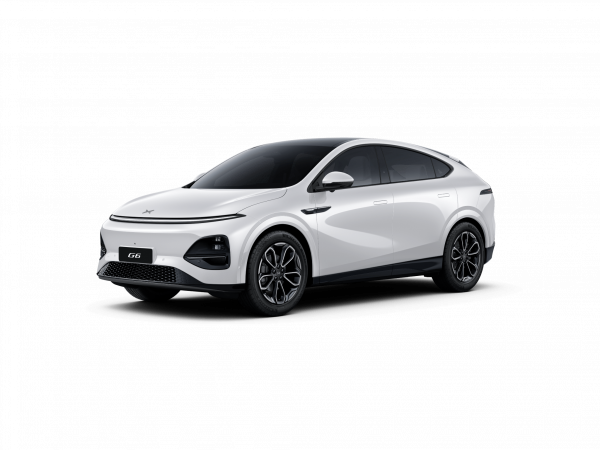
The latest XPENG G6 puts most of its technology into charging speed, battery control, cabin computing and assisted driving. Australian specifications list an 800V silicon-carbide electrical platform, a 5C LFP battery and DC charging of up to 451 kW, allowing a 10%–80% charge in about 12 minutes under suitable conditions. Long Range versions offer up to about 525–535 km of WLTP range, while the AWD Performance model produces 358 kW and reaches 100 km/h in 4.13 seconds. A 15.6-inch touchscreen, OTA updates, XPILOT Assist, 360-degree cameras and phone-based controls cover most daily digital functions.
For an elctric suv, charging hardware affects long-distance use more than screen size or app count. The G6 uses a full-domain 800V high-voltage SiC platform rather than the roughly 400V architecture still found in many EVs, allowing high power to be delivered without requiring the same current level for an equivalent charging rate.
The latest Australian G6 pairs that architecture with an 80.8 kWh LFP battery in Long Range and Performance versions. XPENG lists a maximum DC input of 451 kW and a 10%–80% charging time of 12 minutes when the charger, battery temperature and starting state of charge permit it.
| Item | Australian New G6 figure | What a driver sees in use |
|---|---|---|
| Electrical platform | 800V SiC | Supports very high DC charging power |
| Battery | Up to 80.8 kWh LFP | No nickel, manganese or cobalt in the LFP cell chemistry |
| Peak DC charging | Up to 451 kW | Short high-power charging stops |
| DC charging window | 10%–80% in about 12 min | Adds 70% of usable state of charge during a short stop |
| WLTP range | Up to about 525–535 km | Fewer planned charging stops |
| AWD output | 358 kW / 660 Nm | 0–100 km/h in 4.13 sec |
| V2L | Up to 6 kW | Can supply external electrical equipment |
The 12-minute figure should not be read as a promise that every public charger will reproduce it. A 150 kW charger cannot supply 451 kW, and charging power normally changes as the battery moves from 10% toward 80%; temperature, battery conditioning and charger sharing can reduce the rate as well.
That is where thermal control becomes part of the charging system rather than a separate comfort feature. XPENG equips the New G6 with XHP 3.0 thermal management, designed to regulate battery, power electronics and cabin temperatures so the battery can remain closer to a suitable working range during charging and cold-weather operation.
Battery chemistry also changed with the 2025-generation update. XPENG moved the G6 range to LFP batteries, listing 68.5 kWh for Standard Range and 80.8 kWh for Long Range and Performance versions; the earlier versions used 66 kWh and 87.5 kWh packs depending on configuration.
LFP normally gives up some energy density compared with nickel-rich chemistries, but it offers strong thermal stability and long cycle life. XPENG states that its 5C battery technology is designed for more than 2,000 fast-charge cycles before battery health reaches 70% under its specified test conditions, although real ageing will vary with temperature, storage state of charge and charging habits.
Range therefore comes from more than battery capacity. The G6 has a quoted drag coefficient of 0.248 Cd, and the Australian AWD Performance specification lists consumption of 18.4 kWh/100 km with 20-inch wheels; aerodynamic resistance becomes increasingly important at motorway speeds because the power needed to overcome drag rises rapidly as speed increases.
The chassis is also conventional enough to make the technology understandable from behind the wheel. Australian specifications list a double-wishbone front suspension, ventilated disc brakes at both ends, a 5.8 m turning radius and selectable Eco, Comfort, Sport and Individual modes.
Performance buyers get a measurable change rather than a software-only badge. The AWD version develops 358 kW and 660 Nm, reaches 100 km/h in 4.13 seconds and has a listed top speed of 202 km/h, while WLTP range remains about 510 km on the specified 20-inch wheel setup.
Inside, the computing layout separates vehicle information from the larger infotainment surface. Australian configurations use a 10.25-inch digital instrument panel together with a 15.6-inch central touchscreen, reducing the need to place speed, navigation, media and vehicle settings on one display.
Wireless Apple CarPlay and Android Auto are included alongside XPENG's own navigation and app environment. Owners who prefer phone-based mapping can stay in a familiar interface, while the native system can display vehicle-specific information that a standard smartphone projection system may not handle in the same way.
Voice control provides another route into the cabin software. The "Hey XPENG" assistant can handle supported vehicle and infotainment commands, so common settings do not always require repeated screen taps; during a 30-minute urban trip, reducing even a few manual menu interactions can matter more than adding another entertainment app.
OTA software support changes what happens after delivery. XPENG states that the G6 can receive updates through Wi-Fi or 4G, with the vehicle notifying the owner when a downloaded update is ready to install; updates can refine existing software or add compatible functions without replacing the physical processors, cameras or radar units.
That distinction matters because software cannot raise a 150 kW physical charging limit to 451 kW or turn an existing camera into a higher-resolution sensor. OTA is more useful for interface revisions, compatibility changes, control calibration and functions already supported by installed hardware.
Assisted-driving hardware covers a different part of daily use. Australian G6 equipment includes XPILOT Assist functions such as adaptive cruise support, lane assistance and automated lane-changing features on applicable versions, with NVIDIA Orin-X computing listed in the current configurator.
XPENG describes XPILOT as driver assistance, not autonomous driving. Its own 2026 guidance tells the driver to remain aware of traffic and to intervene when steering, distance or speed assistance does not respond correctly, particularly on wet roads, poor-visibility roads, motorway exits or changing traffic conditions.
Parking makes wider use of the same camera and sensor network. A 360-degree surround view reduces the amount of bodywork that disappears below window level, which is useful in a vehicle measuring roughly 4.75 m long and 1.92 m wide; close kerbs and narrow parking bays are easier to judge when several camera angles are combined on one screen.
Cabin packaging also benefits from an EV platform that does not need a conventional transmission tunnel or large combustion drivetrain. The Australian AWD specification lists 571 litres of luggage space with the rear seats in use and up to 1,374 litres when they are folded, alongside seating for five occupants.
Front-seat equipment moves beyond heating. Current G6 specifications include 12-way electric adjustment, ventilation and heating on applicable seats, while higher equipment levels add massage functions; the combination is more useful on a 500 km journey than a short showroom demonstration because seat temperature and posture become more noticeable after several hours.
The electrical system can also send battery energy outside the car. Australian AWD specifications list V2L output of up to 6 kW, enough on paper to supply several moderate-power devices as long as their combined demand stays within the vehicle's rated output and the connected equipment meets local electrical requirements.
V2L turns the traction battery into a portable power source for camping equipment, computers or suitable tools without adding a second large battery. Using 2 kW continuously for three hours would consume about 6 kWh before conversion losses, around 7.4% of an 80.8 kWh pack.
Phone access adds another layer without requiring the driver to sit inside the car. The current connected system supports functions such as automatic phone unlocking and vehicle-related app controls, while Bluetooth, UWB remote-key technology and an NFC card provide several ways to gain access when one method is inconvenient.
The charging numbers become more useful when translated into travel time. Moving from 10% to 80% adds 70% of battery state of charge; on an 80.8 kWh pack, that corresponds to roughly 56.6 kWh of nominal battery energy, so a 12-minute stop requires very high average charging power even though the instantaneous rate can rise or fall during the session.
Public infrastructure remains part of the equation in 2026. A G6 connected to a 350 kW station cannot draw its advertised 451 kW peak, while a charger capable of 450 kW or more still needs suitable voltage, temperature and site conditions before the car can approach its maximum rate.
The battery, charging electronics and navigation therefore work best when the driver plans around the usable 10%–80% window instead of routinely waiting for 100% at rapid chargers. Charging normally slows as state of charge becomes high, making the final portion less time-efficient during a motorway stop.
Safety hardware sits alongside the convenience systems rather than replacing ordinary driving responsibility. XPENG references a five-star Euro NCAP result for the G6 family, while Australian equipment includes seven airbags, tyre-pressure monitoring, ISOFIX mounting points, automatic hold and an acoustic vehicle alerting system.
For day-to-day ownership, the strongest numerical difference from an older EV may still be charging rather than acceleration. Moving from the previous G6's peak figures of about 215–280 kW to as much as 451 kW in the newer generation raises the theoretical charging ceiling by more than 60% compared with the earlier 280 kW maximum, while the claimed 10%–80% time falls to around 12 minutes.
Real-world users will see smaller or larger differences depending on the charger network they use. Someone charging at home on 11 kW AC will not benefit from a 451 kW DC peak overnight, whereas a driver covering several hundred kilometres in one day can encounter the difference at every suitable rapid-charging stop.
The Australian configurator lists 11 kW AC charging and about 9.2 hours for a 5%–100% charge on the AWD Performance version. That slower overnight rate matches the use case: the car can sit for hours at home, while the 12-minute 10%–80% figure is intended for high-power public charging during longer journeys.